

Women In Malta Work Longer Hours Than Many Women Across The EU, Eurostat Data Shows

Women in Malta are putting in some serious hours at work, with the latest Eurostat data showing that Malta remains firmly on the longer-working side of Europe.
In 2025, workers aged between 20 and 64 in Malta averaged 37.5 actual hours per week in their main job, compared to an EU average of 35.9 hours.
And when looking specifically at full-time workers across Europe, women worked an average of 37.6 hours per week, while men averaged 39.4 hours.
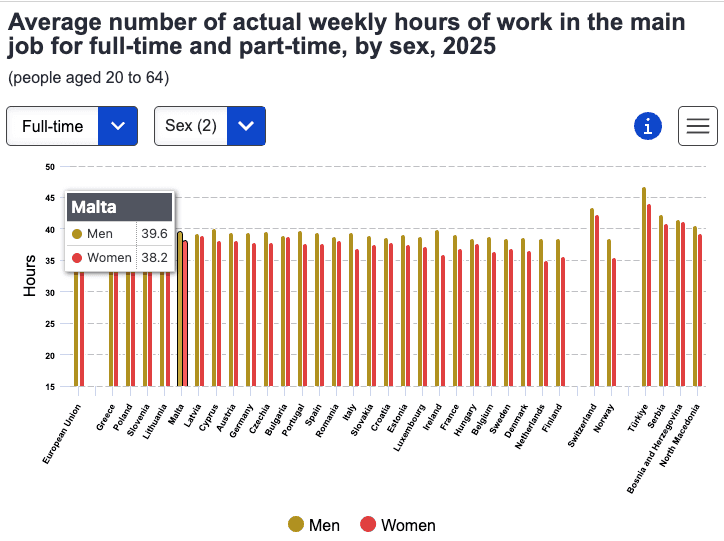
For full-time women, the longest working weeks in the EU were recorded in Slovenia at 39.2 hours, followed by Lithuania at 39.1 hours, with Latvia and Poland both at 38.9 hours.
At the other end, women working full-time averaged just 35 hours per week in the Netherlands, 35.6 in Finland, 35.9 in Ireland and 36.4 in Belgium.
Among men, Greece recorded the longest average full-time working week at 41.8 hours, followed by Poland at 40.6, Slovenia at 40.2 and Cyprus at 40 hours.
Interestingly, the picture changes when looking at part-time employment.
Across the EU, women working part-time actually averaged slightly more hours than men, at 21.9 hours per week compared to 21.7 hours for men.
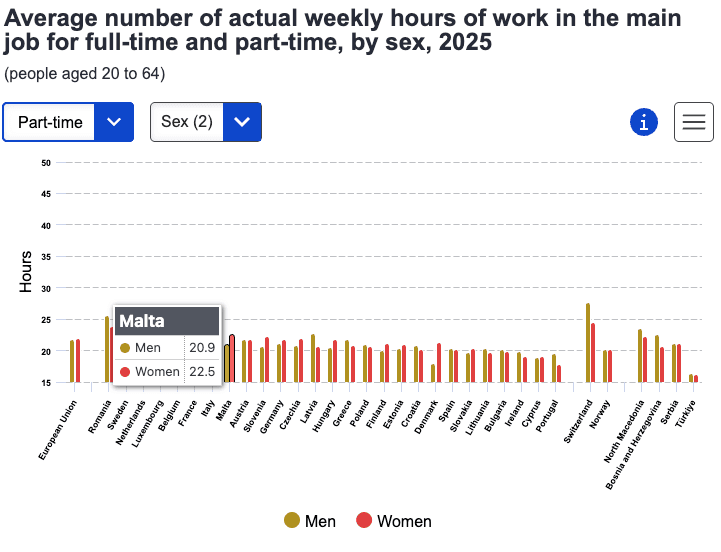
Eurostat also noted that women working part-time recorded longer average weeks than men in many EU countries.
The figures are another reminder of the significant contribution women continue to make in workplaces across Malta and Europe, both in full-time and part-time employment.
However, working longer hours should not automatically be interpreted as being more productive or “hardworking”, as Eurostat’s figures measure time spent working, rather than output, effort or productivity.
“Actual hours worked” include time genuinely spent working during the reference week, including extra hours and unpaid overtime. Holidays, sick leave and commuting are excluded.
Across the EU as a whole, people worked an average of 35.9 hours per week in 2025, with Greece recording the longest overall week at 39.6 hours and the Netherlands the shortest at 31.9.
One thing is clear: Malta continues to rank among Europe’s longer-working countries, with women playing an important part in that workforce.
#MaltaDaily
