St Augustine’s Former, Forgotten Religion: Manichaeism
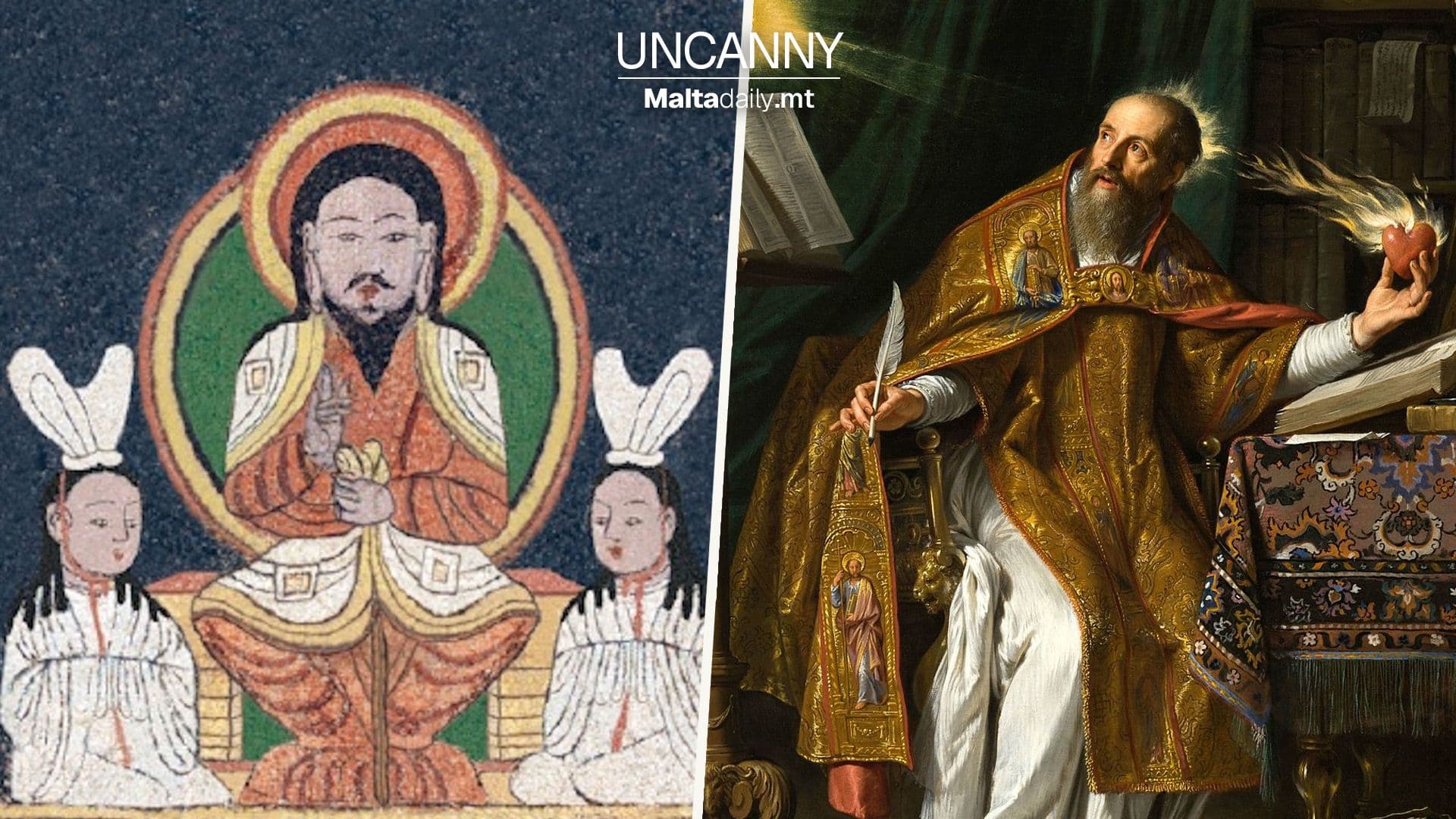
Augustine of Hippo (354-430) is one of Christianity’s most well known theologians and philosophers. Some of his writings, like ‘The City of God’ and ‘Confessions’, massively influenced the trajectory of Christendom.
But did you know that Augustine was not always a Christian? Before his conversion in 387, Augustine followed Manichaeism.
Manichaeism is a former major world religion founded in the 3rd century CE by the Parthian prophet Mani (216-274) in the Sasanian Empire. Mani himself was born into a family of Elcesaites, a group of Jewish Christian Gnostics.
There’s a lot to unpack there already, but what is crucial to know is that Christianity in this period was still finding its footing, with a vast number of groups taking on the label of Christian, even if we wouldn’t recognise them as such today. The Elcesaites focused heavily on baptisms for purification and often found themselves being critiqued by early Church Fathers for heresy.
Mani would however go on to report having visions at a very young age, breaking off from his family’s tradition to found his own religious movement. This movement would be incredibly syncretic, drawing from all the faiths it encountered as it spread.
This syncretism could be seen in Mani referring to himself as both the Apostle of Jesus and the Buddha of Light.
As a ‘Silk Road Religion’, Manichaeism started to blend Eastern and Western ideas through shared spiritual language. His followers saw him as a divine messenger bringing enlightenment to all peoples. Manichaeism presented itself as a universalist and missionary religion, spreading far and wide.
The Cao’an Temple in Jinjiang, China, is regarded as the only surviving Manichaean temple in the world. Within it, Mani is portrayed as a Buddha, reflecting how local beliefs reshaped his image. This spread was aided by the structure of Manichaeism’s followers, split into ’The Elect’ and ‘The Hearers’ or ‘Catechumens’.
The former needed financial support as they were not allowed to carry out very basic actions like farming or harvesting (we’ll discuss why later). The Hearers would in turn provide food to the Elect who, through the process of eating, say, a fruit, liberate the spiritual light trapped within. This brings us to the beliefs of the Manichaeans. Texts by the likes of Augustine need to be taken with a grain of salt due to their polemic nature.
Thankfully, there are other surviving sources. The Mani Codex, discovered in Egypt in the 20th century, is a book no bigger than a credit card. Dating to the 5th century, it preserves early stories about Mani’s life and calling.
We learn how In his first vision, Mani’s spiritual twin revealed that divine light was trapped in material darkness. Manichaean cosmology is intensely dualistic: there is a light world ruled over by the Father of Greatness and a World of Darkness.
In the process of creation, these two worlds infiltrate each other, making the world we live in a cosmic drama with humans tasked with liberating the light from dark. Remember the food and the Elect? This is where the beliefs become practice. Due to the Elect being unable to do any harm to vegetation so as not to participate in the forces of darkness, they were unable to provide for themselves.
So, the Hearers would bring them food, with the Elect blessing both the Hearer and the food and liberating the light through the process of eating. This practice was actually mocked by St Augustine. In his Confessions, he writes:
“I was led to the absurd trivialities of believing that a fig tree weeps when it is picked […] Yet if some Manichee saint ate it, provided that the sin of picking it was done not by his own hand but by another’s, then he would digest it in his stomach and as a result would breathe out angels, or rather as he groaned in prayer and retched he would bring up bits of God.’
It is worth noting that Augustine’s mother went to great lengths to turn her son away from Manichaeism. His later theological attacks must be read in a context of rich religious diversity, even if Augustine ended up rejecting the religion with intensity. And Manichaeism was not some fringe cult either, for Mani received the support of the Sasanian King Shapur I.
Despite Shapur never converting to Manichaeism, remaining a Zoroastrian, Mani did devote his only Middle Persian text to him: the Shabuhragan (‘Dedicated to Sabuhr’). Mani also is said to have described himself as a Paraclete, a Christian term meaning ‘advocate’ or ‘helper.’ This is a decisively Christian move, following particularly in the footsteps of St Paul (whether he did this consciously or not is another matter).
So there you have it – a very brief glimpse into an ancient religion we only have traces of today through ancient texts, paintings and buildings. How much of Manichaeism survived through other religious traditions is difficult to deduce.
But it does remind us of just how versatile the ancient world was in terms of religious variety… Very much like ours today!
#MaltaDaily