

PN Says Maltese Workers Falling Behind European Wage Rankings
The Nationalist Party has said Maltese workers’ wages are continuing to fall behind those of European counterparts, arguing that the economic growth highlighted by the Labour Government is not translating into better pay for lower-income workers.
In a statement signed by PN Shadow Ministers Julian Borg, Darren Carabott, Adrian Delia and spokesperson Annabella Cilia, the party referred to figures published by Eurofound, claiming that Malta has dropped from eighth place in 2016 and 2021 to 15th place in 2026 among EU Member States in terms of the national minimum wage.
The PN said that seven countries which previously had lower minimum wages than Malta have now moved ahead, naming Slovenia, Lithuania, Poland, Cyprus, Portugal, Croatia and Greece. It argued that these countries had advanced through stronger wage policies, while Maltese workers had continued to lose ground in European rankings.
According to the statement, Malta’s minimum wage increased by 3.5% between 2025 and 2026, reaching around €994 per month. The PN compared this with larger increases recorded in countries including Hungary, Slovenia, Bulgaria, Slovakia and Lithuania.
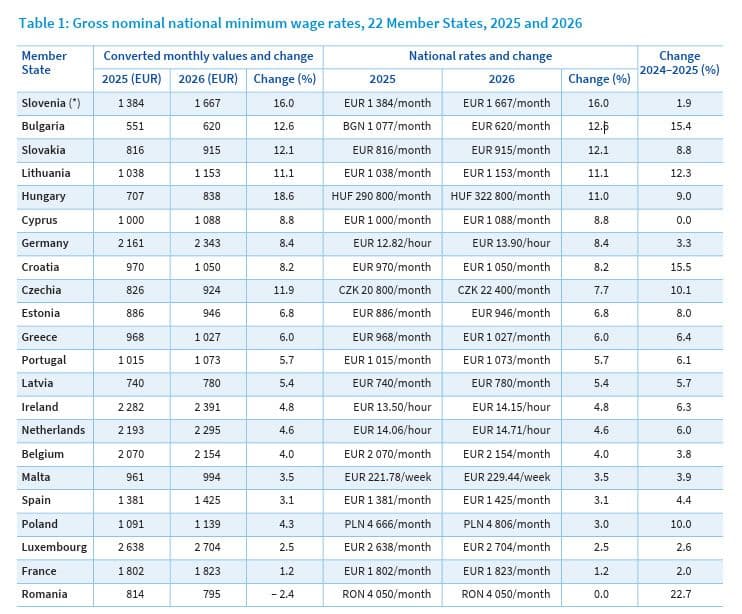
The party also highlighted that the increase in Malta’s minimum wage was smaller than the previous year, rising by around €7.50 per week compared with a 3.9% increase between 2024 and 2025. It said the current national minimum wage stands at €229 per week.
The PN claimed that the figures show that the country’s economic growth has not resulted in sufficient improvements for workers, arguing that the Government has failed to create an economy based on higher added value and productivity that can support stronger wages.
The statement also linked wage concerns to the wider cost of living, saying that increases in food prices, rent, property costs and other essential expenses are placing additional pressure on families.
The PN also referred to recent comments by Finance Minister Clyde Caruana regarding the rising cost of energy subsidies, claiming that this raised questions about the sustainability of Government spending and electoral commitments.
The party argued that Malta’s economic success should not only be measured through GDP growth but also by whether workers can maintain a decent standard of living. It called for a change in the economic model, focusing on productivity, investment in skills, quality jobs and wage growth linked to the wealth generated by the economy.
The statement concluded that workers should be able to feel the benefits of economic growth through their incomes rather than only through economic indicators.
#MaltaDaily
