

People In Malta Work Longer Hours Than The EU Average, New Eurostat Data Shows

People in Malta are working longer weeks than the average European worker, according to the latest figures from Eurostat.
In 2025, employed people aged between 20 and 64 in Malta worked an average of 37.5 actual hours per week in their main job, compared to an EU average of 35.9 hours.
That puts Malta around 1.6 hours above the EU average every week, placing the country towards the higher end of the European rankings.
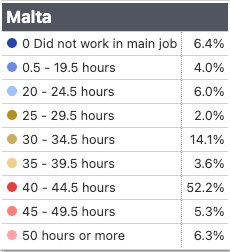
Malta was joint 10th-highest in the EU alongside Czechia, with only nine EU countries recording longer average working weeks.
At the top was Greece at 39.6 hours, followed by Poland and Bulgaria at 38.7 hours, Lithuania at 38.4 and Slovenia at 38.3. Romania, Latvia, Croatia and Cyprus also recorded longer weeks than Malta.
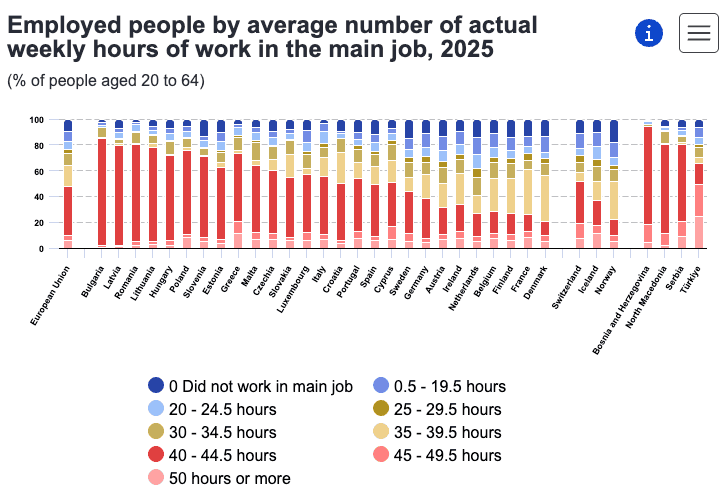
Meanwhile, workers in several northern European countries spent considerably less time at work.
The Netherlands recorded the EU's shortest average working week at 31.9 hours, followed by Denmark and Germany at 33.9 hours and Austria at 34 hours.
And Malta's longer working hours also show up when looking at specific jobs.
Skilled agricultural, forestry and fishery workers in Malta worked around 42.4 actual hours per week, while plant and machine operators and assemblers averaged around 40.2 hours.
Importantly, Eurostat's figures include both full-time and part-time workers, meaning countries with a larger proportion of part-time employment can naturally record lower overall averages.
“Actual hours” also means time actually spent working during the reference week, including overtime, but excluding holidays, sick leave and commuting time.
Across the EU as a whole, the average working week has fallen from 36.9 hours in 2015 to 35.9 hours in 2025.
So while the European working week appears to be getting shorter overall, Malta remains firmly on the longer-working side of the EU.
#MaltaDaily
