


HOW THE D&D MORAL PANIC RUINE THE LIVES OF REAL EDDIE MUNSONS
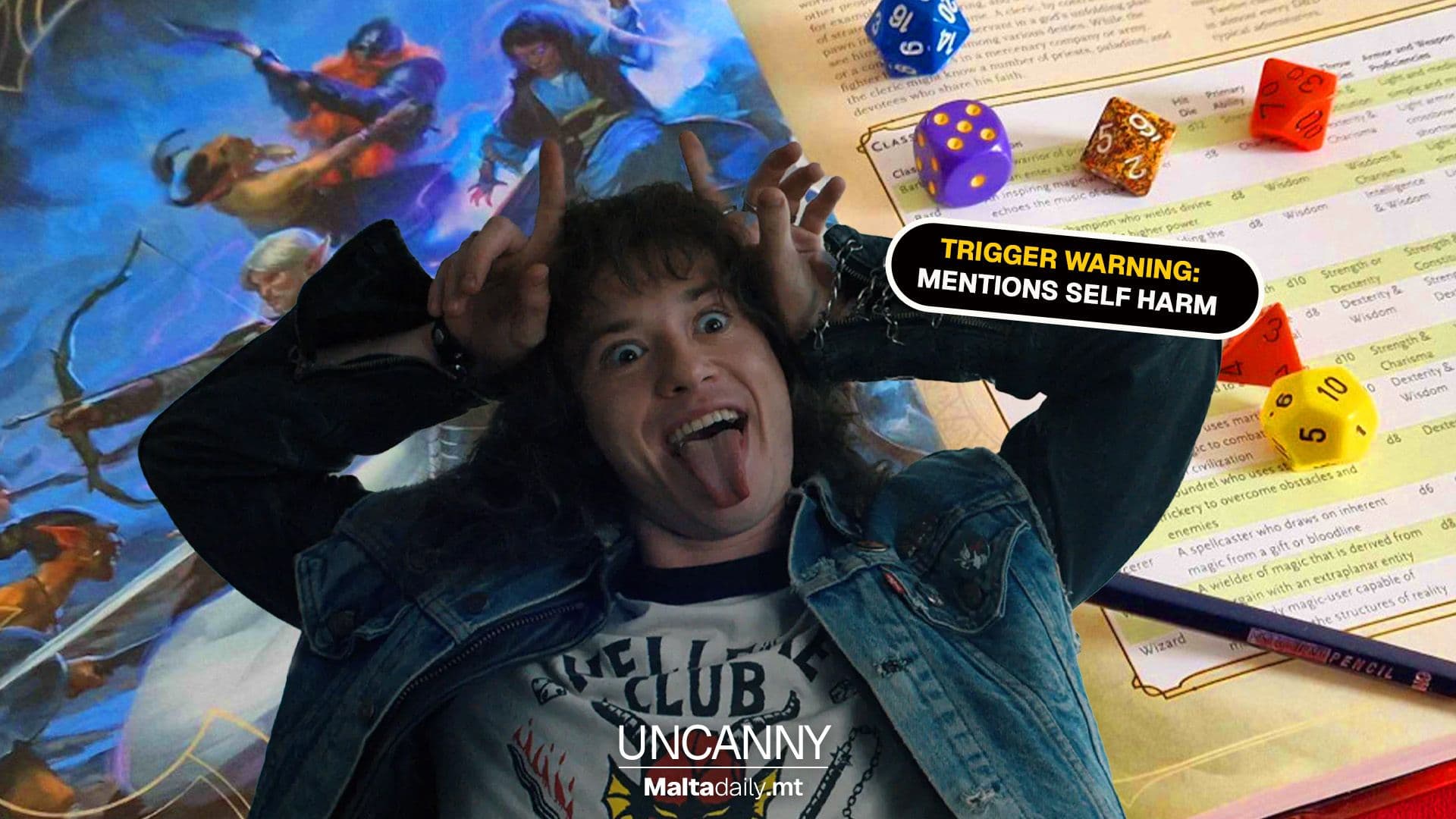
During Season 4 of Stranger Things, we see a monster hunt take place which accused Eddie Munson of murdering senior cheerleader Chrissy Cunningham.
We, as viewers, of course know that it was the villain Vecna who was really to blame.
However, due to a blend of his peculiar charisma, alternative lifestyle & love for Dungeons & Dragons, Munson became the victim of a town-wide moral panic.
All supernatural happenings aside, this season of Stranger Things was picking up on something that actually happened in 1980s American culture.
This panic, and the related ‘Satanic Panic’, led to the destruction of many innocent lives after serious but unfounded accusations were made against teachers, civil servants and even family members.
Here is the story of some of the real Eddie Munsons and how moral panics spread.
In 1979, the disappearance of 16-year-old James Dallas Egbert III at Michigan State University became one of the first incidents linked, incorrectly, to Dungeons & Dragons.
A private investigator suggested that Egbert had vanished due to becoming obsessed with the game, despite no evidence for this claim. The idea was that he had entered underground tunnels for a fantasy-inspired mission.
In truth, Egbert struggled with depression and substance misuse. He later died by suicide in 1980, but his case fuelled the notion that D&D posed psychological dangers to young people.
The case inspired books and films, such as Mazes and Monsters (1981) and its 1982 adaptation starring Tom Hanks, which depicted roleplaying as psychologically dangerous.
These works blurred fact and fiction, creating a lasting association between fantasy gaming and mental instability. Many viewers accepted the fictional portrayals as cautionary tales based on true events.
As media stories multiplied, D&D’s connection to the Egbert case became a cultural myth, laying the groundwork for the decade’s moral panic.
In 1982, another tragedy struck when American student Irving Lee Pulling died by suicide. His mother, Patricia Pulling, attributed his death to a D&D game played shortly before he died.
Believing the game had placed a “curse” on her son, she filed lawsuits against his school principal and D&D’s publisher, TSR Inc. Both were dismissed, as there was no evidence to support her claims.
Despite this, Pulling founded an organisation called Bothered About Dungeons & Dragons (BADD), which became one of the most vocal critics of the game.
Pulling described D&D as a gateway to a wide range of immoral and occult practices. She warned parents that it contained “demonology, witchcraft, blasphemy and suicide” among other dangers.
BADD gained significant traction in religious and mainstream media, particularly through television and church publications. Pulling appeared on the US programme 60 Minutes, debating the game’s co-creator Gary Gygax.
Through these platforms, her campaign helped frame D&D as not just a game but a possible threat to children’s wellbeing and faith.
Religious groups and conservative commentators soon adopted Pulling’s arguments. Preachers and community leaders claimed that D&D could invite demonic possession or moral corruption.
In 1985, pastor Jon Quigley called it “an occult tool that opens up young people to influence or possession by demons”. Statements like this were widely repeated.
This is what sociologist Stanley Cohen called a ‘moral panic’: a widespread feeling of fear that an evil group/person threatens the values or well-being of a community.’
Not all Christians agreed with these views. Some players, including practising believers, defended the game as harmless creativity.
Dr David Waldron, a historian of religion and folklore, explained that the panic arose because fantasy stories about magic were perceived as directly opposed to biblical teachings.
He also noted that many adults believed young people were unable to distinguish between imaginary play and real-world behaviour, a view not supported by psychological evidence.
Media coverage amplified these fears. Newspapers and television shows frequently repeated unverified claims linking the game to suicide, violence and occultism.
Such reports were often published without context or critical scrutiny, spreading what Waldron called “a wide-ranging list of bizarre claims”.
Among the most common was the idea that when a player’s in-game character died, the player might also attempt suicide in real life.
A few writers and researchers began to challenge these claims. Author Michael Stackpole was among the first to analyse BADD’s arguments systematically.
His 1990 publication The Pulling Report identified factual errors and questioned Pulling’s credibility as an expert witness.
Independent studies by medical and governmental bodies, including the US Centers for Disease Control, found no causal link between D&D and suicide or mental illness.
Nevertheless, several high-profile crimes were still connected to D&D by the press. One of the most widely reported was the 1988 murder of Lieth Von Stein in North Carolina.
Because the perpetrators happened to play D&D, commentators suggested that the game had influenced their actions. Subsequent investigations found motives rooted in greed and substance use, not fantasy gaming.
Despite this, the case was adapted into books and television dramas that reinforced the association between D&D and dangerous obsession.
By the late 1980s, D&D’s publisher TSR began quietly removing references to demons and devils from its materials, hoping to avoid further controversy.
In later editions, these creatures were renamed with invented terms such as “baatezu” and “tanar’ri”. Many players continued to use the old names privately.
As the 1990s progressed, the panic faded. Patricia Pulling died in 1997, and BADD dissolved shortly afterwards.
Wizards of the Coast, the new owner of D&D, restored much of the removed content in later editions. Public opinion shifted as earlier fears proved unfounded.
Concerns over Dungeons & Dragons in the 1980s closely resemble later fears about violent video games. Titles such as Mortal Kombat, Doom and Grand Theft Auto were accused of encouraging aggression or desensitising players to violence.
Repeated studies by the American Psychological Association and other research bodies have found no clear causal link between playing violent games and committing violent acts, yet the debate continues to resurface with each new generation of media.
Today, D&D is widely recognised as a positive creative outlet.
Role-playing games encourage creativity, collaboration and problem-solving, helping players build empathy and social confidence through shared storytelling.
Yet, the 1980s moral panic remains a reminder of how fear and misunderstanding can stigmatise ordinary people — the real “Eddie Munsons” of their time.
#MaltaDaily